Billie Eilish's neon green roots over black hair became one of the most recognizable examples of deliberate root color. The look was not a few green highlights near the face. It used a connected, high-contrast section across the scalp and crown, with black hair preserved around and below it. That clear separation is why the style fits the modern idea of ghost roots so well.
She first revealed the neon yellow-green roots in July 2019, then wore variations of the green-and-black placement through prominent appearances in 2019 and 2020. In August 2023, she returned to the same root-first idea in vivid red. The color changed, but the visual formula remained recognizable: bright pigment at the top, dark lengths underneath, and enough section width for the roots to become the design.
Visual Ideas
Four Views of Billie Eilish's Green And Red Root Placement
These references compare the broad green crown panel on short and long hair, the same placement in a loose updo, and the later vivid-red version against black lengths.

Lime Green Root Panel With A Dark Bob
The lime section covers most of the visible crown, then stops above the black bob. A dark center of new growth is visible along the part, which makes this photograph useful for separating the colored panel from later regrowth.
The green is broader than a narrow part-line stripe. It follows the top of the head and feeds into the front pieces, while the black perimeter keeps the two-color structure readable.
Use this reference when the goal is a wide crown panel with black ends, not scattered green highlights or a hidden underlayer.

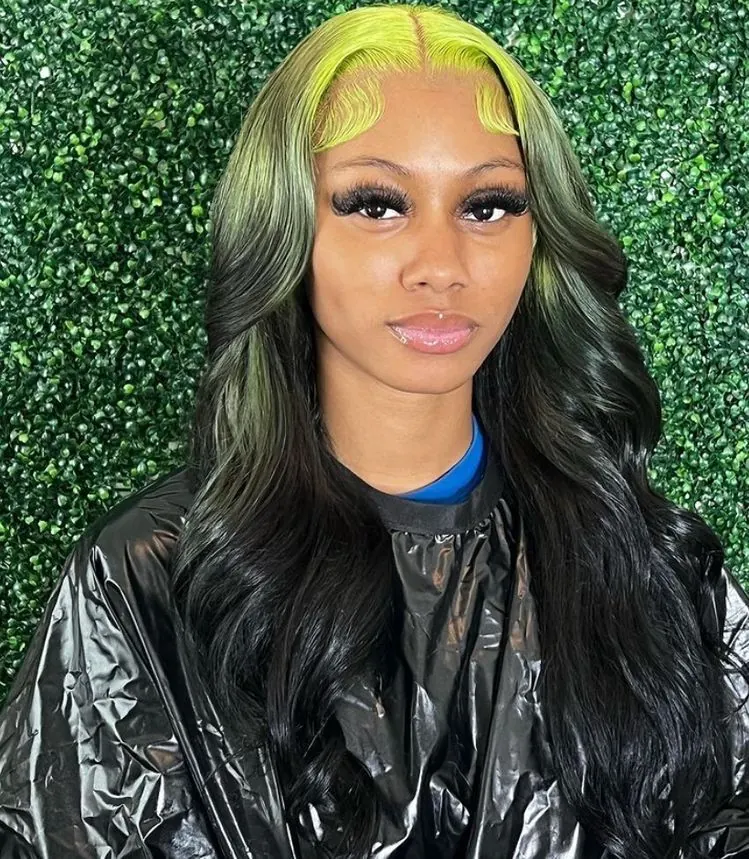
Long Black Hair With An Acid-Green Top Section
Here the acid-green color forms a connected top section rather than isolated pieces. Long black lengths and two dark face-framing strands narrow the green visually when the hair is seen from the front.
The green travels farther back than the fringe, but the front view makes it look almost like a bright cap divided by a slim dark part and black side panels.
Bring a top or side reference as well as this front view if you want a colorist to reproduce the panel width accurately on long hair.

Green Roots In A Loose Oscars Updo
At the 2020 Academy Awards, the same green-and-black color map was pulled into a loose updo. The lifted shape exposed the bright crown while black tendrils and gathered lengths framed it from below.
This angle shows why styling matters: lifting the dark lengths makes a broad root panel look more dominant than it does when the hair hangs straight.
If you regularly wear updos, ask the colorist to assess the panel with the hair lifted so its back edge does not extend farther than expected.

Vivid Red Roots With Long Black Lengths
The later red version keeps the recognizable formula: saturated color at the scalp, a broad top panel, and black through the lengths. A clean center part divides the red while two long black front sections sharpen the face frame.
Red feels denser and warmer than the acid green, but the underlying section map is similar. The contrast comes from preserving an uninterrupted black perimeter and black lengths.
Use this image to communicate a broad red crown panel. For a smaller commitment, ask for the same red family in a narrower center-part or fringe section.
Why Billie Eilish's Green Hair Reads as Ghost Roots
Four details make the green look more specific than ordinary dyed roots:
- The color begins at the scalp. Green is attached to the root zone instead of appearing as disconnected highlights through the lengths.
- The section is intentionally broad. It covers much of the crown in the strongest versions, so it reads from the front, above, and side.
- The black lengths remain dominant. The dark perimeter gives the bright section a clean boundary and prevents the result from becoming all-over green hair.
- Styling changes the reveal. Straight hair narrows the visible green from the front, while an updo exposes more of the crown and the back edge of the panel.
The photographs below show those relationships at different lengths and angles. They are most useful as placement references: compare where the green begins, how far it travels across the crown, and where black resumes.
The Green-Root Era Began in 2019
Contemporary coverage records that Eilish revealed her neon green roots in early July 2019. By March 2020, the colored-root look was closely associated with her public image and was influencing wider beauty coverage.
The 2020 Oscars photograph is especially useful because it shows the placement outside a straight, hair-down style. Eilish wore the black-and-green hair in a loose updo, which exposed more of the fluorescent crown. Black pieces were left around the face and through the gathered hair, preserving the contrast even though the silhouette changed.
This is also why one photograph cannot fully specify the service. A front portrait explains the color balance around the face, but a top or three-quarter angle explains the width and rear boundary of the root panel. Anyone taking this look to a salon should bring more than one view.
Billie Eilish's Red Ghost Roots Used The Same Visual Formula
Eilish revived the vivid-root placement in August 2023 with bright red instead of green. Contemporary reporting credited colorist Jess Gonzalez and described the shade as a saturated, true red rather than auburn or copper.
The red version is not merely red hair with dark regrowth. Red begins at the scalp and fills a deliberate top section, while the surrounding hair remains black. Its center part and dark face-framing strands make the boundary particularly easy to read from the front.
- Color impression
- Green rootsAcidic, fluorescent, cool-to-yellow green
- Red rootsSaturated, warm, true red
- Base and lengths
- Green rootsBlack
- Red rootsBlack
- Main placement
- Green rootsBroad crown and top panel
- Red rootsBroad crown and top panel
- Strongest visual feature
- Green rootsExtreme neon contrast
- Red rootsDense red against a dark perimeter
- Likely fade concern
- Green rootsYellowing, muddiness, or loss of fluorescence
- Red rootsLoss of saturation or a warmer, duller red
If red is the direction you prefer, the red ghost roots guide compares narrower center stripes, fringe sections, crown panels, burgundy, cherry, crimson, and copper alternatives. You do not need to reproduce the full Billie Eilish panel width to retain the red-on-black idea.
How to Describe The Look to a Colorist
Start with the placement, then name the shade. A useful request would be:
I want a connected vivid root panel across the top and crown, with black left through the perimeter and lengths. Please map the panel with my hair both down and lifted, and tell me how light the section must become before applying neon green or vivid red.
Confirm these decisions during the consultation:
- Whether the panel should cover most of the crown or stay narrow beside the part
- Whether black front pieces should remain for face-framing contrast
- Where the colored section should stop at the sides and back
- How the placement will look with your normal part, bangs, ponytail, or updo
- Whether the existing hair can be lightened safely enough for the chosen shade
- Whether future appointments will refresh pigment, lighten new growth, or reshape the panel
The ghost roots hair dye guide explains why applying vivid pigment to an already prepared section is different from repeatedly lightening dark roots. A strand test is especially important when the hair contains old black dye, previous bleach, uneven bands, or breakage.
A Smaller Version Can Keep The Idea Without Copying The Full Panel
Billie Eilish's best-known version is broad, but the useful design principle is contrast, not exact duplication. A narrow center-part stripe, split-fringe section, or smaller crown panel can still place vivid green or red at the roots while reducing the amount of hair involved.
Short bobs expose a root panel quickly. Long straight hair can hide its side and back boundaries unless the hair moves. Bangs make front placement more visible but also bring frequent washing, heat styling, and trims. An updo exposes the crown, so the colored area can look larger than it does with the hair down.
Compare the general green ghost roots guide if you want neon, lime, chartreuse, mint, or forest-green alternatives. Before committing to a broad vivid panel, use the maintenance guide to separate pigment fading from new-growth maintenance.
The Name Describes The Technique, Not a Claim That She Coined it
Coverage from 2019 and 2020 commonly called the look neon green roots, colored roots, or a root pop. Ghost Roots uses ghost roots as the site-wide term for intentionally contrasting color placed at or immediately beside the scalp. This article does not claim that Billie Eilish invented or named the technique.
What made her version influential was its clarity: a fluorescent root field, black surrounding hair, and repeated public styling that showed the same color map from different angles. It remains a strong reference because a stylist can see both the shade relationship and the placement boundary.
Billie Eilish Ghost Roots FAQ
When did Billie Eilish first wear green roots?
She revealed the neon yellow-green root look in July 2019 and continued wearing green-and-black variations through major appearances in 2019 and 2020.
Did Billie Eilish also have red ghost roots?
Yes. She debuted vivid red roots over black hair in August 2023. The color changed, but the broad crown placement and dark lengths echoed her earlier green-root look.
What should I ask for to get Billie Eilish-style roots?
Ask for a connected vivid panel across the top and crown with black preserved through the perimeter and lengths. Bring front and top views so the colorist can map the panel width, then discuss whether your hair can be lightened safely enough for neon green or vivid red.
Editorial Note
Dates, credits, and public appearances discussed on this page were checked against contemporaneous reporting before publication. Research records are retained internally by the editorial team.