
Definition and visual identification
What are ghost roots?
Ghost roots are intentional contrasting color placed at or immediately beside the scalp while the surrounding hair remains a different shade. The colored root zone becomes part of the finished design rather than something meant to resemble untreated regrowth.
The phrase is not standardized across salons. On this site, a look counts when deliberate contrast begins at the root zone, whether it follows a narrow part, broad crown panel, fringe, face frame, or hidden under-root section. A color band beginning farther down the hair, ordinary regrowth, and a shadow root used only to soften a transition are different ideas.
A definition you can use
Identify six things, not one trend name.
If you can describe these six features, you can explain the result even when a stylist uses different terminology.
- 1. Root shade
- The intentional color at or immediately beside the scalp: red, blue, blonde, white, silver, or another contrast.
- 2. Base and lengths
- The color outside the root feature. The relationship may be high contrast, softly related, or multitone.
- 3. Placement
- The part line, crown, fringe, face frame, side section, halo, selected rows, or another named root zone.
- 4. Edge
- The boundary may be graphic, diffused, melted, feathered, or deliberately irregular.
- 5. Visibility
- The color may remain exposed from the front or appear only when the hair is lifted, parted, curled, or tied.
- 6. Movement
- Texture and styling determine whether one colored section reads as a stripe, halo, broken curl pattern, or flashing underlayer.
Placement map
Where the color sits changes what the look means.
Use the placement name to describe the colored root zone, then add its width, edge, and usual visibility. More than one zone can appear in the same design.
Part line
A narrow section follows a center, side, or irregular part. It stays visible from above and usually creates the clearest line between the root shade and surrounding hair.
Crown panel
A broader colored area covers the top of the head rather than one thin part. Curls, layers, and changing the part can break the panel into smaller visible sections.
Fringe or front roots
Color begins at the roots beneath bangs or front pieces. The placement remains close to the forehead and can follow a blunt, split, curtain, or irregular fringe.
Hidden halo
A ring or broad under-root section sits beneath the top layer. It appears when the hair lifts, separates, is tied up, or moves away from its resting position.
Read the evidence in the image
Twelve images, twelve placement decisions.
These reviewed photographs compare narrow and broad sections, exposed and hidden color, loose and braided texture, fringe and face-frame placement, plus sharp and diffused boundaries. Together they show which visual details make the color part of the root design.
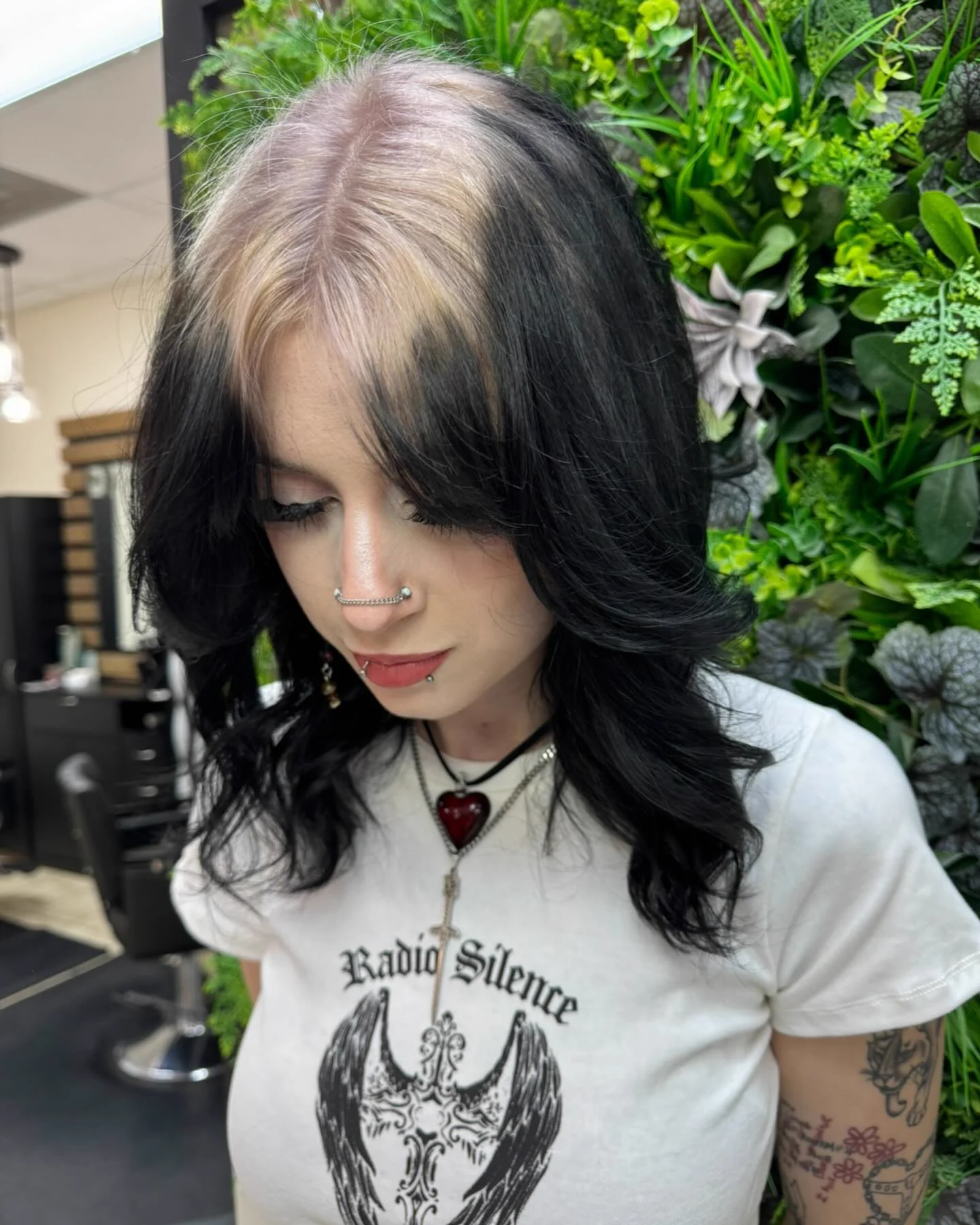
Example 1 · Exposed part-line panel
A broad pale crown panel stays visible beneath the black curtain fringe
The platinum-white color starts directly at the scalp on both sides of the center part, then spreads across most of the front crown. Black curtain pieces fall over its outer edge, showing that a root panel can remain clearly visible without coloring the fringe or lengths. This image is especially useful for judging the panel's width, symmetry, and sharp boundary against the black base.
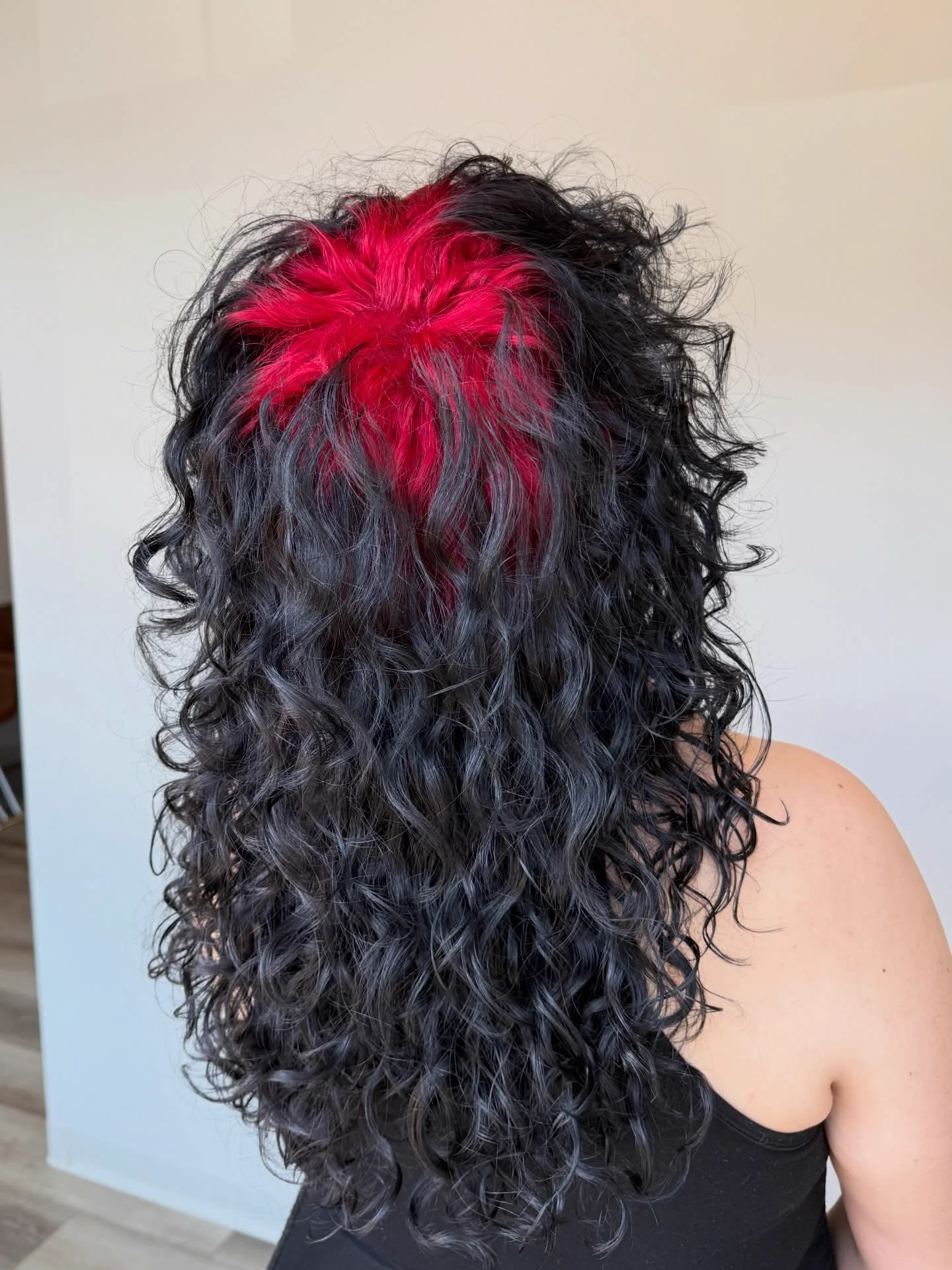
Example 2 · Crown placement on curls
Curls divide a bright red crown panel into separate flashes of color
Bright crimson-red covers a concentrated crown area and begins at the scalp beneath the black curls. Because individual curls lift, overlap, and turn in different directions, the panel reads as several flashes of red rather than one flat circle. The photograph demonstrates why crown width should be planned with the finished curl pattern in mind: more black can return between the colored sections once the hair is styled.
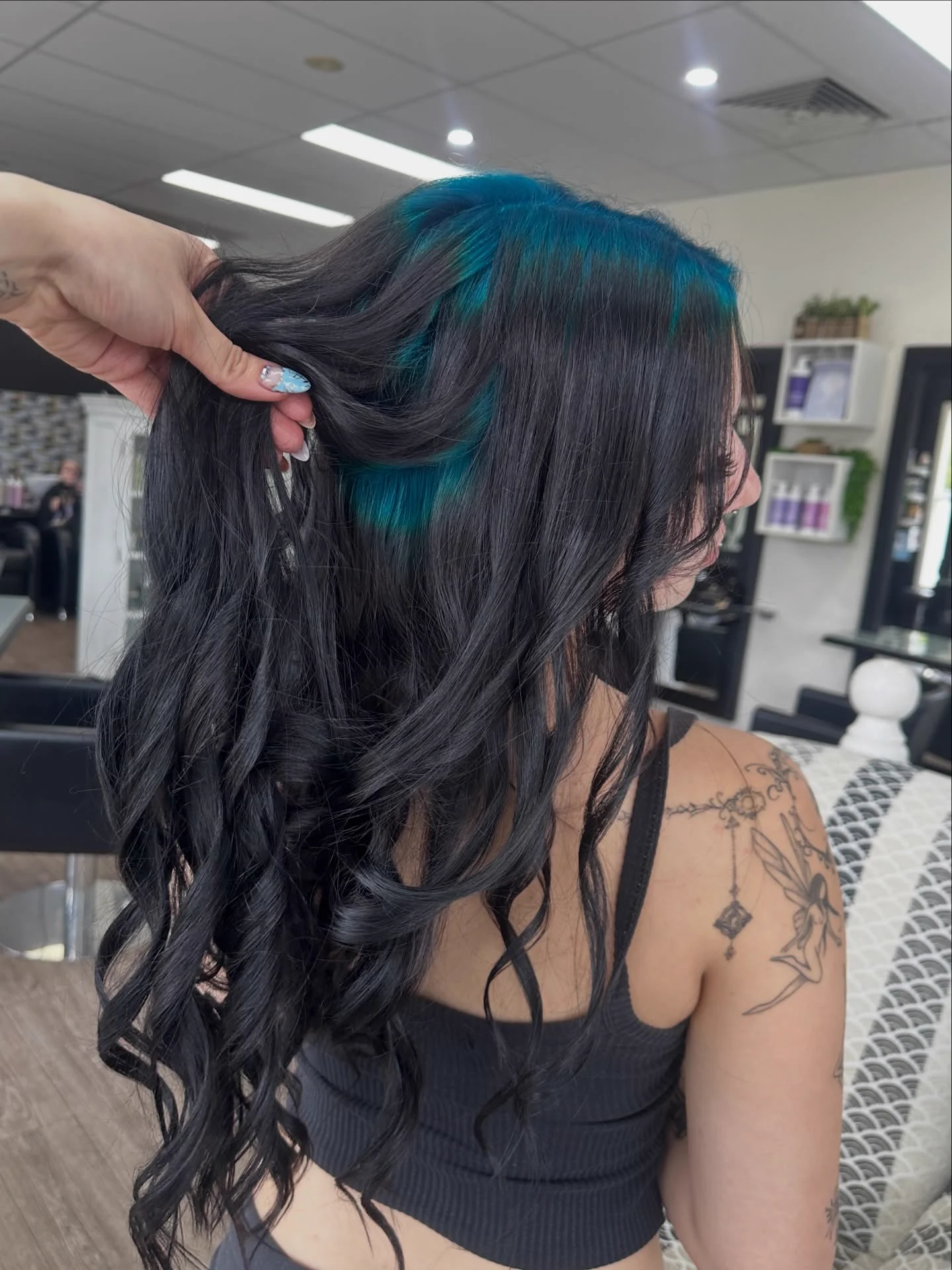
Example 3 · Hidden root halo
A lifted surface layer reveals the teal root section underneath
The upper black layer is lifted to expose teal beginning at the roots across the side and upper back section. When that black layer falls back into place, much of the teal can disappear, leaving only smaller glimpses near the part or through movement. This makes the reference useful for discussing hidden placement, reveal points, and how much colored hair should remain visible when the style is worn down.
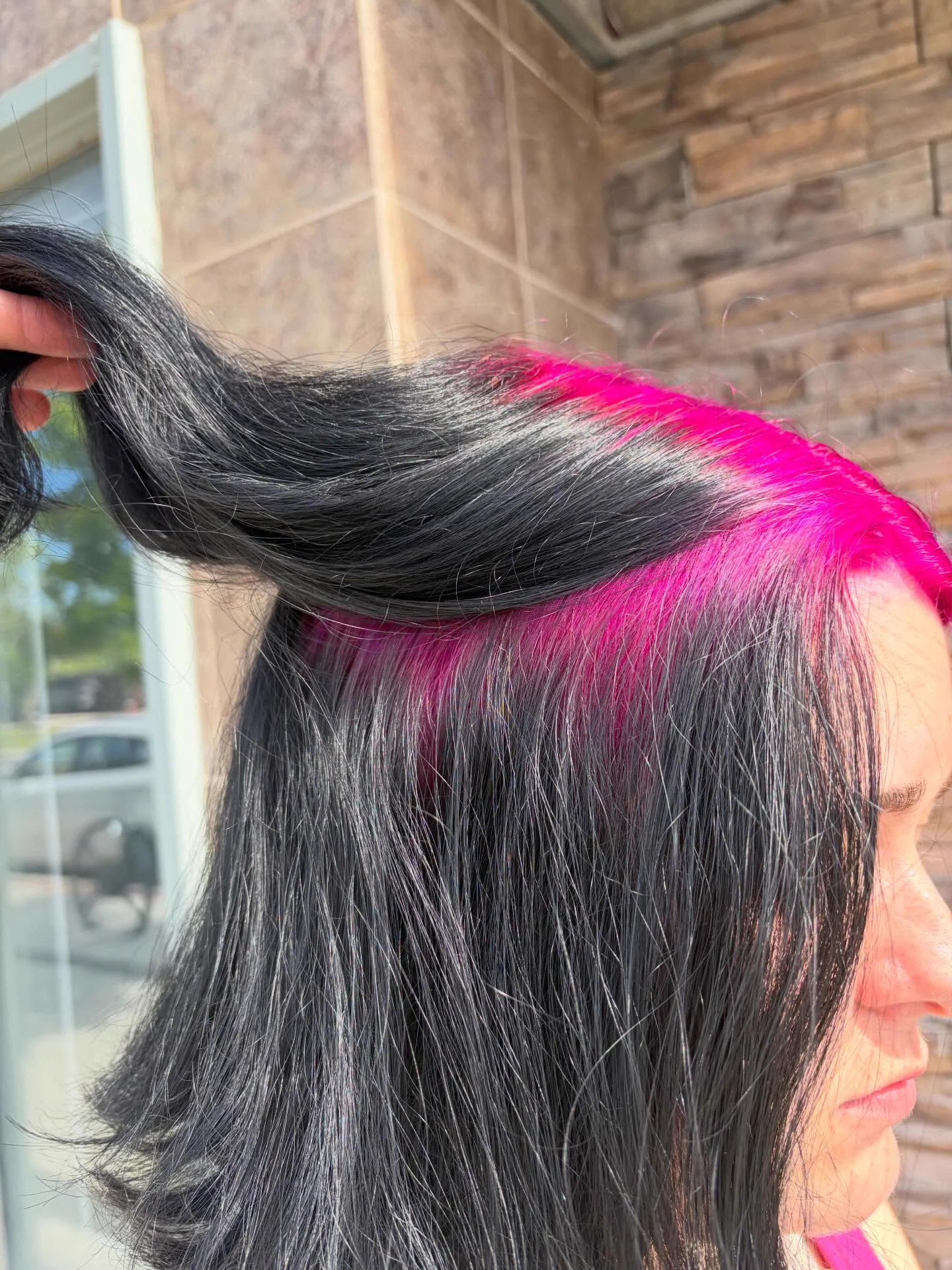
Example 4 · Side root-panel detail
Lifting one side exposes the full width of a hot-pink root panel
The lifted black hair reveals a saturated hot-pink panel that begins at the scalp near the temple and continues backward toward the crown. Its lower edge remains hidden beneath the black surface layer, while its front edge stays close enough to the hairline to flash from the side. The close framing is valuable because it shows the actual section depth and boundary more clearly than a finished front portrait would.

Example 5 · Narrow part line
A narrow yellow stripe defines the center part without covering the crown
Neon yellow begins at the hairline and stays close to the center part, leaving most of the surrounding roots and all of the long lengths black. The straight finish makes the stripe's width and symmetry easy to compare from left to right. This is the clearest example on the page of a part-line placement that creates strong contrast with relatively little colored hair.
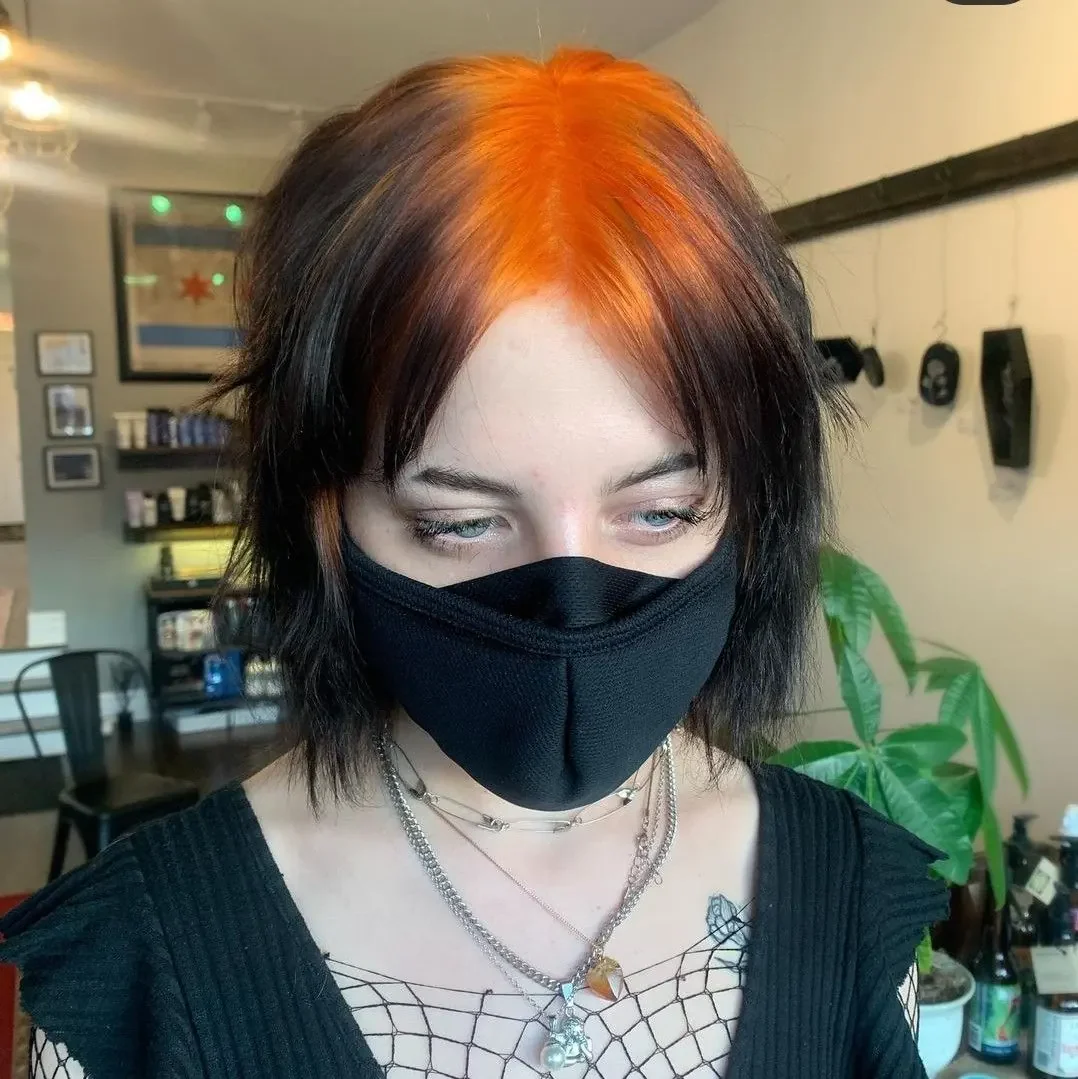
Example 6 · Fringe roots
Orange-red roots follow the opening of a split fringe
The warm orange-red section starts at the front scalp and continues into the two pieces created by the split fringe. Black remains at the outer crown, side layers, and ends, so the root color is concentrated around the forehead rather than spread across the whole top. It shows how fringe placement can stay visible from the front even when little of the crown is exposed.
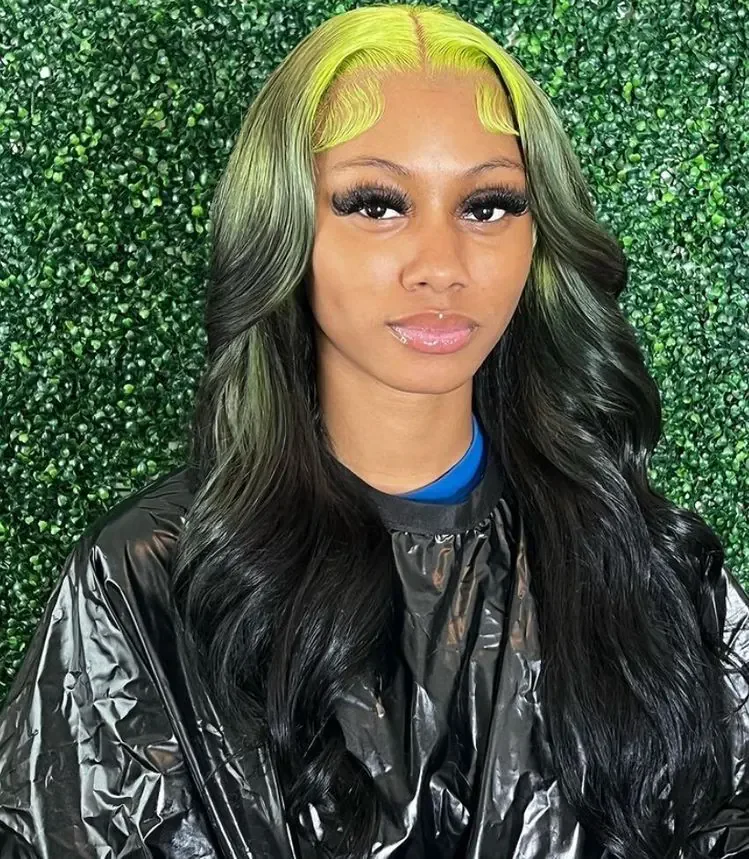
Example 7 · Root-connected face frame
Chartreuse starts at the front roots and continues into a face frame
Chartreuse begins at the front hairline on both sides of the center part, then continues into the shorter pieces beside the face. The central crown and long body waves stay black, which keeps the bright color concentrated around the complexion. This image helps separate a root-connected face frame from a money piece that begins farther down the length.
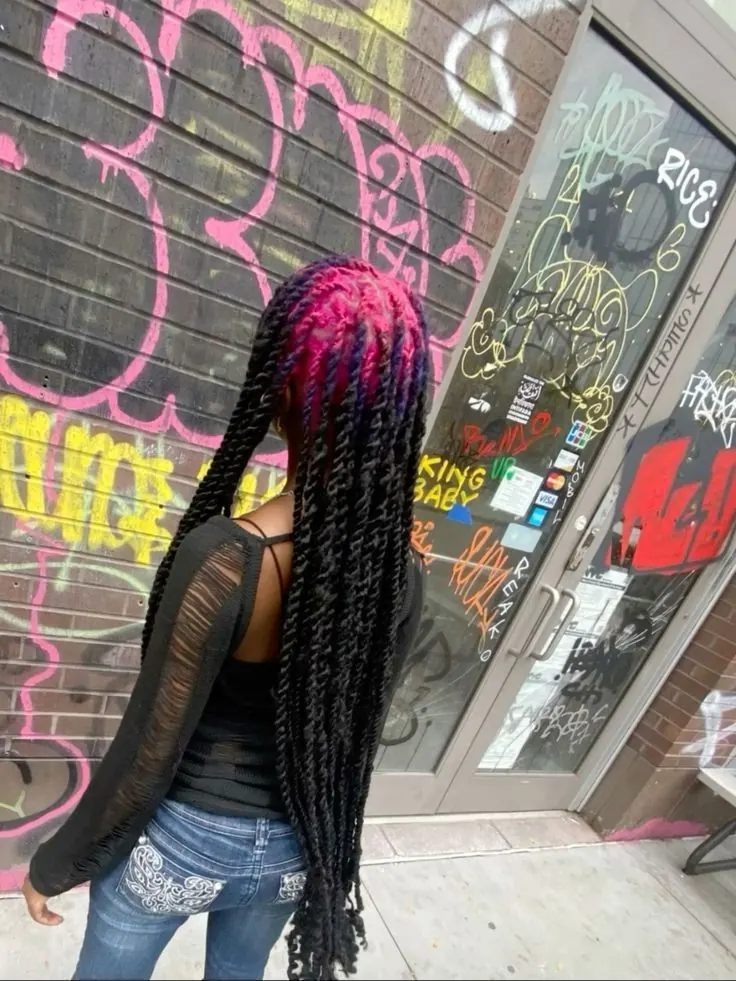
Example 8 · Braided root rows
Magenta at the scalp makes the box-braid sectioning visible
Magenta is concentrated at the scalp across the upper braided section while the full braid lengths remain black. Each parting exposes a small area of color, so the finished effect is organized by the braid pattern rather than by loose-hair movement. It demonstrates why selected rows and parting geometry should be planned before the hair is braided.
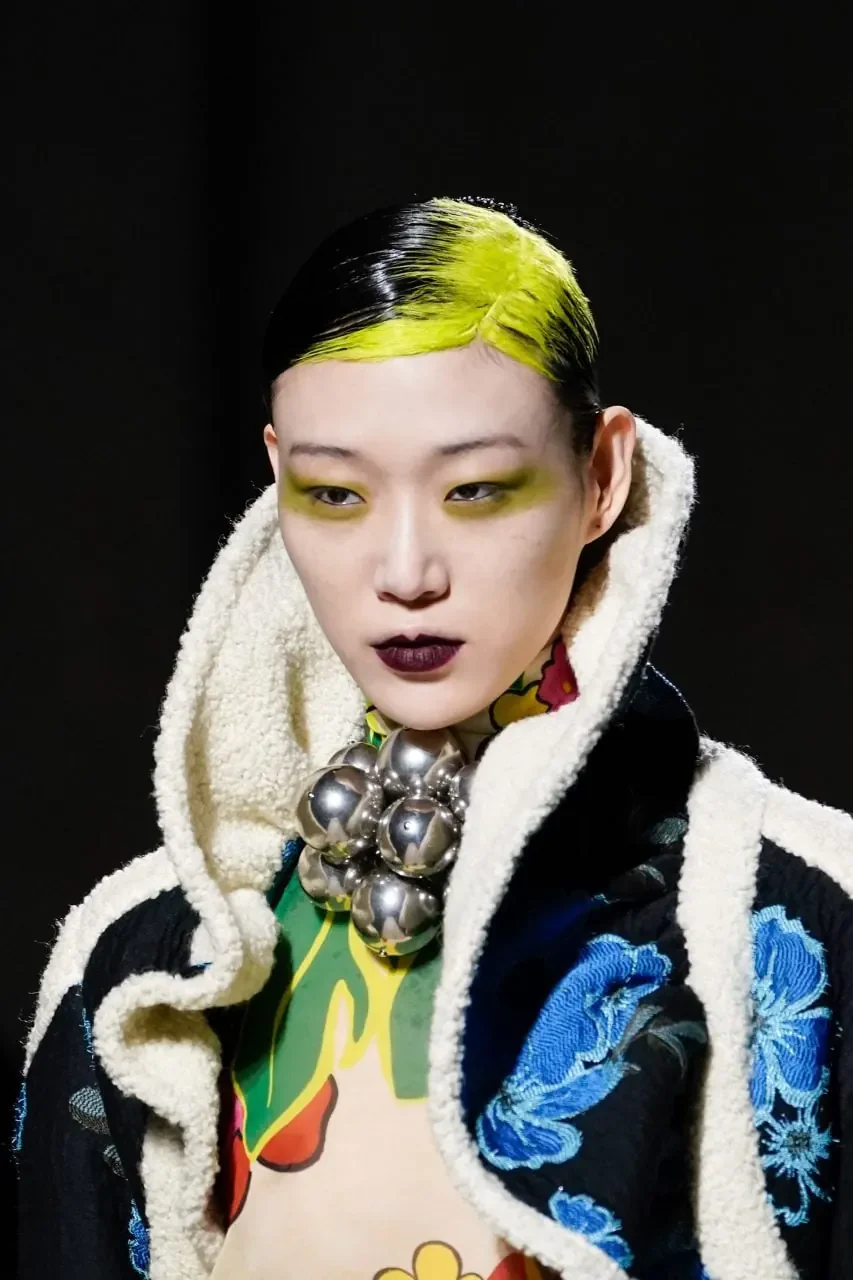
Example 9 · Exposed root wash
Slicked-back styling exposes the full shape of a yellow root wash
The hair is combed tightly away from the face, exposing a broad neon-yellow area from the front hairline through the upper crown. Black remains around the sides, making the irregular outer edge of the colored section easy to see. Unlike a hidden halo, this placement is designed to stay exposed whenever the hair is worn back.
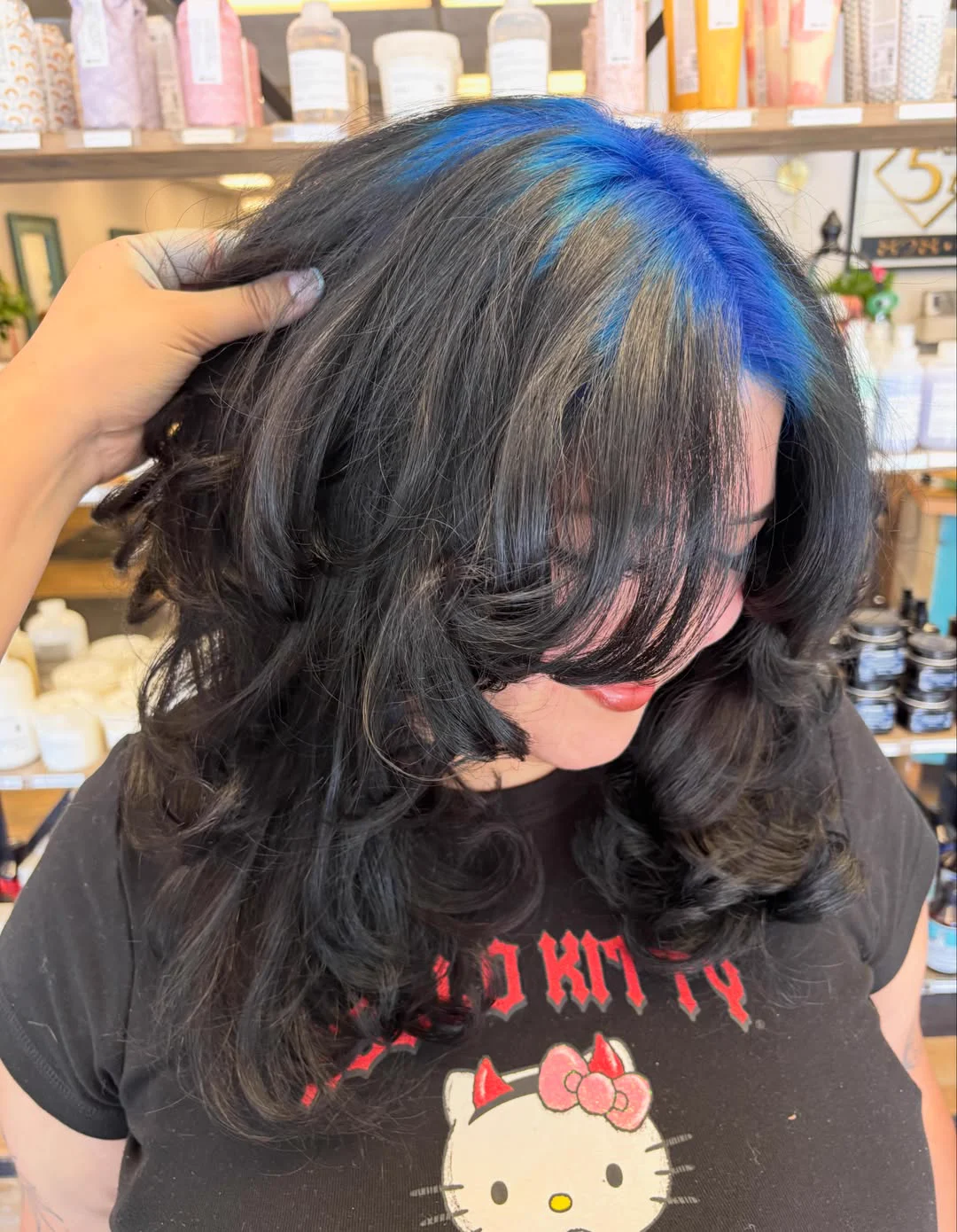
Example 10 · Asymmetric side part
A side part makes one blue crown section appear wider than the other
Electric blue begins at the scalp and follows a side part, creating a wide visible section on one side and a narrower flash on the other. The black front layers partly cross the blue as they curve around the face. This is useful for understanding that the same sectioning can look unbalanced after the wearer changes the direction of the part.
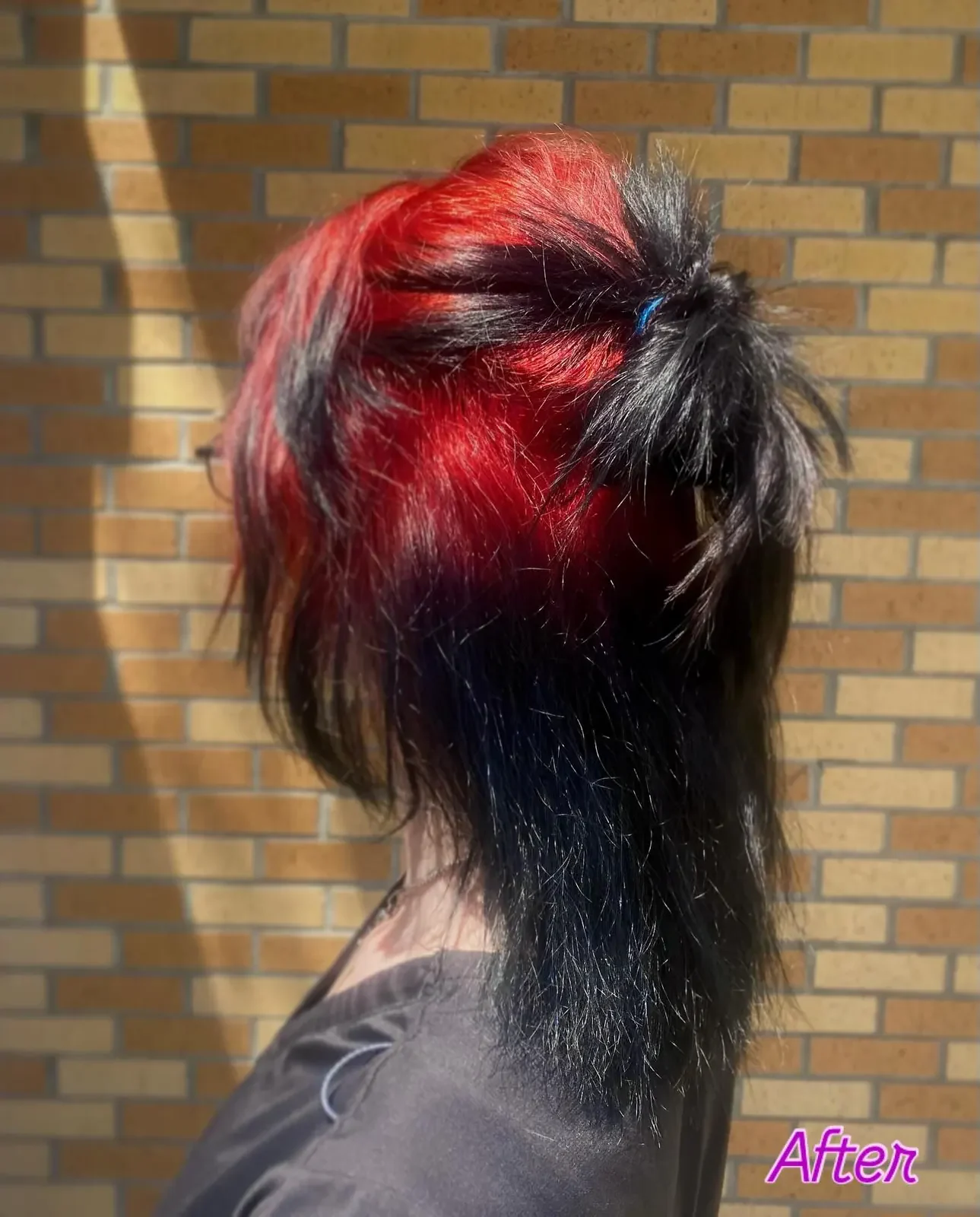
Example 11 · Visibility in an updo
An updo reveals red roots that loose lengths can partly conceal
Pulling the hair upward exposes a red section that begins at the scalp and spreads across much of the crown and upper back. Black remains through the gathered ends and lower lengths, but the tied style removes the surface coverage that would soften the red when worn down. The image shows why root placement should be checked in the wearer's usual ponytail, bun, or half-up style.
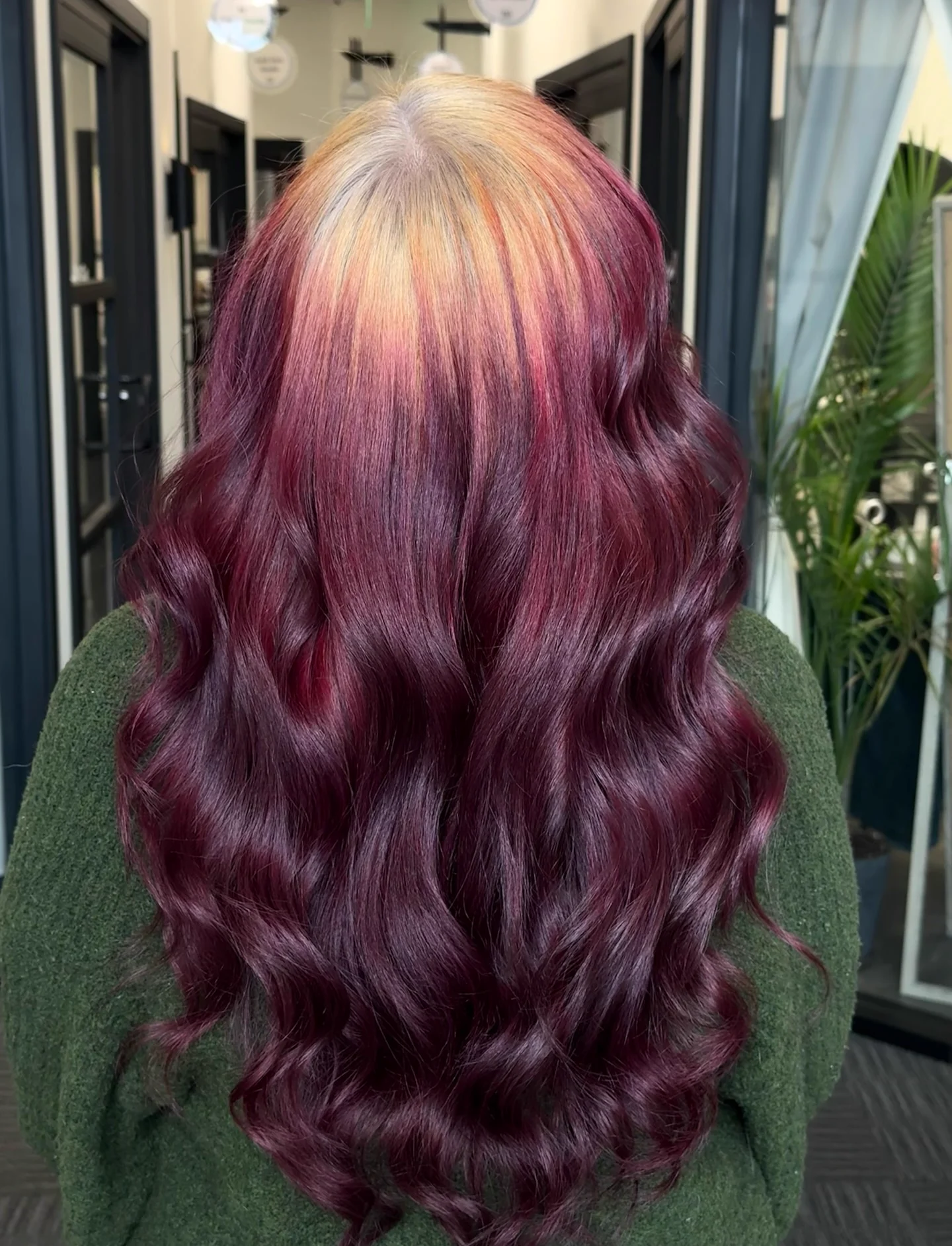
Example 12 · Diffused root boundary
A pale crown uses a softer boundary against burgundy-red lengths
Pale blonde covers most of the upper crown, then breaks into fine warm strands before meeting the burgundy-red body color. The transition is still intentional and visible, but it is less graphic than the sharp white, pink, and yellow boundaries elsewhere on the page. This comparison shows that ghost roots can use a diffused edge without disappearing into an ordinary shadow root.
Do not confuse the purpose
Ghost roots compared with adjacent looks.
The same photograph can contain more than one technique. This table identifies the primary job each term usually describes; salon language still varies.
| Concept | Primary purpose | What usually makes it different |
|---|---|---|
| Ghost roots | Make contrasting root color part of the visible design. | The root zone itself is intentionally colored and meant to be noticed, even if the placement is hidden some of the time. |
| Ordinary regrowth | Describe new natural hair growing after a previous color service. | It happens over time rather than being placed as the original design. |
| Shadow root or root smudge | Soften the transition between the natural root and lighter lengths. | The root is commonly deepened or blended to reduce a harsh line, rather than highlighted as the contrasting feature. |
| Money piece | Brighten or color the hair framing the face. | The defining area is the front lengths; it may connect to the roots, but the face frame is the main feature. |
| Peekaboo or underlayer color | Hide color beneath a surface layer. | The colored section may begin away from the scalp. A hidden root halo is closer to ghost roots when the intentional color clearly begins at the root zone. |
| Color blocking | Place distinct fields of color beside one another. | It is a broader design method. Ghost roots can use color blocking, but the root zone must remain the defining colored field. |
| Reverse grow-out | Create the appearance of a contrasting root area on purpose. | The phrase describes the visual reversal of concealed regrowth, while ghost roots more precisely identifies where the intentional color is placed. |
| Angel ring or halo hair | Form a horizontal band of light or color around the head. | The band often begins below the scalp. It becomes a ghost-root placement only when deliberate color clearly starts in the root zone. |
Context without a claimed origin
Two references sharpen the definition.
There is no single documented inventor or standardized formula for ghost roots. These examples are useful because they show where the root-first idea overlaps with, and separates from, adjacent looks.
A runway illusion, not permanent dye
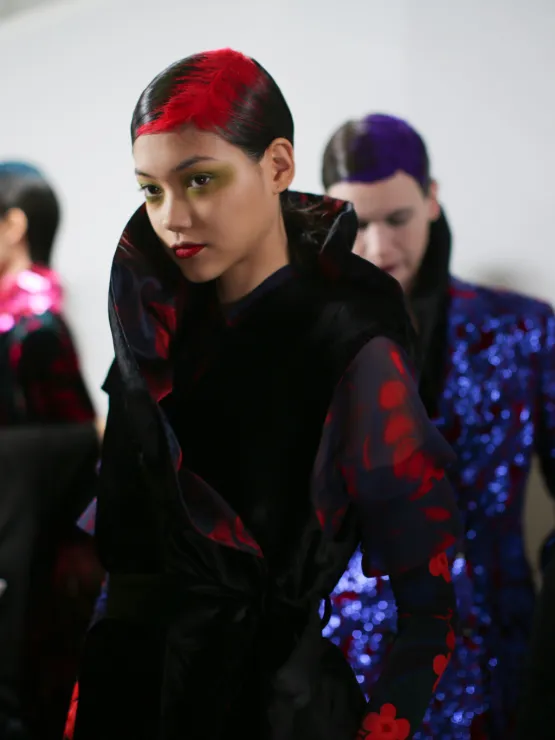
At the Dries Van Noten Fall 2020 show, hairstylist Sam McKnight created the appearance of vivid roots on slicked, parted hair by fixing crimson, fuchsia, violet, and lime marabou feathers at the scalp with hairspray. The material was temporary, but its position and contrast made the result read like colored roots.
A recognizable dyed root panel
Billie Eilish's neon-green roots over black lengths, followed later by a red version, provide a clearer example of dyed color beginning at the scalp. The broad top panel, dark perimeter, and black lengths make the placement legible from several angles. The Billie Eilish ghost roots guide examines those versions in detail.

A quick identification test
Ask what the image actually shows.
- Can you see intentional color beginning at the scalp or immediate root zone?If not, the image may show lengths, an underlayer, or face framing rather than a root placement.
- Can you name the section?Look for a part line, crown, fringe, side panel, face frame, halo, or selected rows.
- Is the contrast part of the finished design?It should read as placed color, not simply untreated new growth after an older service.
- Does styling change the visibility?Note whether curls, a side part, an updo, loc rows, or lifted layers reveal or break up the root color.
Translate the reference
Describe the result without saying only “ghost roots.”
“I want [shade] beginning at the [root zone], placed through the [part, crown, fringe, face frame, or halo]. Keep the edge [graphic, diffused, or melted], and show me how it will look with my usual [part, curl pattern, loc style, fringe, or updo].”
Then ask what must be lightened, how the shade is expected to fade, and when the placement will stop following the haircut. Those questions belong to the process and maintenance guides rather than the definition itself.