Red ghost roots can change the whole shape of dark hair without sending red through every length. A narrow crimson part looks precise and graphic. Burgundy spread across the crown feels deeper and softer. Copper placed around the front hairline warms a brunette bob. The important decision is not simply which red you like, but where that red begins, how wide it becomes, and how sharply it meets the base color.
The 21 reviewed examples below were selected to show materially different placements, textures, and red families. Use them to compare the visible root boundary, not as a request to copy every detail of a model's cut or styling.
The Billie Eilish ghost roots guide includes her vivid-red crown placement as a documented celebrity example and compares it with the earlier neon green version.
Visual Ideas
How Red Changes at The Part, Fringe, And Crown
These red ghost roots examples show how crimson, cherry, copper, and burgundy placement can work on dark bases without losing shape.

Copper-red roots shaped around a wavy bob
The copper begins at the front root zone and follows the curve of the bob instead of forming a flat stripe across the crown.
This reference is useful for warm brunette hair because the root color remains clearly red-orange while the surrounding auburn lengths soften its boundary.
The short wave repeatedly exposes the front section, so a relatively small colored area remains visible without needing red through every layer.

A burgundy center part with a controlled edge
Straight hair makes the width of the burgundy section easy to judge: it begins at the part, remains narrow near the face, and does not scatter through the black lengths.
Burgundy gives less brightness than crimson but preserves a visible red cast in the root zone, which makes this a useful reference for someone who wants depth rather than neon color.
Show the stylist the desired width at the hairline as well as the crown. A center-part panel can widen quickly if only the front view is discussed.

Burgundy roots carried into a full fringe
Here the red is not relying on a visible center part. The fringe root area carries the contrast, while the black waves keep the lower silhouette dark.
The side portrait shows how far the burgundy travels behind the fringe, a detail that a straight-on photograph would hide.
Because bangs are trimmed and heat-styled more often, this placement can lose both its shape and its tone earlier than a crown panel.

Crimson roots above long dark locs
The crimson sits across the scalp-adjacent hair above the long dark locs, so the color reads from the crown rather than appearing only through the ends.
Use the visible scalp sections as the placement map. The red connects across the front and crown while the dark locs preserve a strong change in color.
This expands the guide beyond loose hair and shows that a root-first red placement can remain readable when the finished style is loc'd.

A crimson crown broken into visible curls
The root panel is continuous near the scalp, but the curl pattern breaks it into smaller red sections as the hair moves away from the crown.
A curly reference should be judged by where the red begins, not by expecting the clean stripe seen on straight hair.
The red occupies enough of the top curls to remain legible from the front, while the black lengths prevent it from becoming an all-over red style.

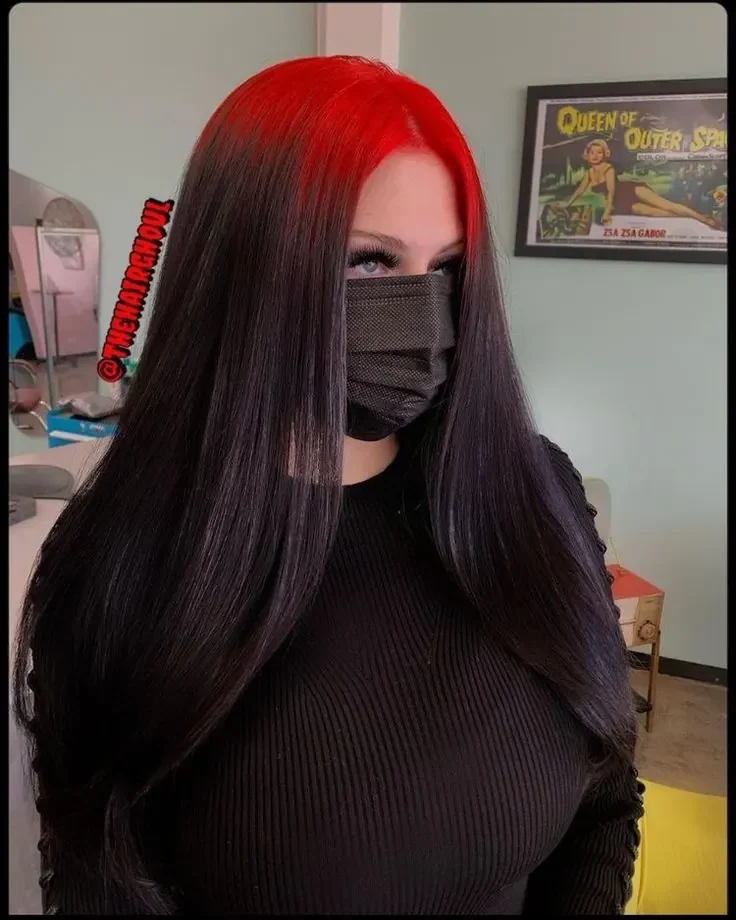
A crimson center panel on sleek black hair
The crimson forms a balanced front panel on both sides of the part, then stops before it takes over the long black lengths.
Use it to discuss panel width and symmetry. The red is broader than a single stripe, but its centered shape keeps the placement controlled.
The smooth black lengths reflect light evenly, which makes any unevenness in the red boundary more noticeable than it would be on waves or curls.
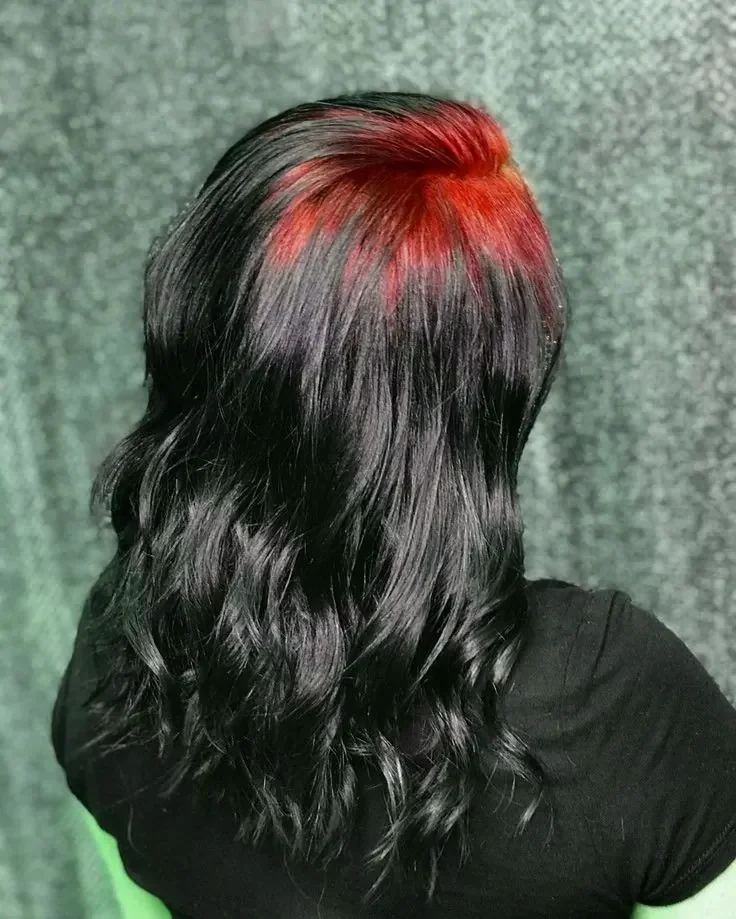
A crimson top panel seen from the back
This back view shows how a centered crimson section can continue over the crown while most of the long wavy hair remains black.
A front portrait cannot show how far the colored panel travels. This angle is useful for setting the stopping point behind the crown.
The red remains concentrated at the top and narrows into the dark waves, preventing the placement from becoming an all-over red upper layer.

Split crimson roots on short black waves
Two red sections sit on either side of the part rather than covering the whole crown, giving the short shape a focused burst of color.
The colored roots occupy a larger share of the visible haircut, so the panel can stay small and still dominate the finished look.
A trim can quickly change where these red sections fall. Color placement and reshaping should be planned together.

A true-red split fringe on a sleek bob
The red is concentrated where the fringe separates, creating a front-facing root feature while the bob remains predominantly black.
The side portrait confirms that the red begins at the root line and does not simply sit on the surface of the bangs.
This clearer true red is brighter than burgundy but less orange than copper, so it gives strong contrast without changing the color story toward pink or violet.

A broad red root wash on slicked-back hair
Slicked-back styling exposes more scalp-adjacent hair than a fringe or center part, so the same color reads as a broad root wash instead of a stripe.
This is the widest placement in the set. It still belongs to the root zone, but it requires more lightening, more visible upkeep, and less room for an uneven boundary.
Someone asking for a narrower everyday result should not use this image alone. Pair it with a center-part or fringe reference to communicate scale.
Cherry-red roots on dark brown lengths
Cherry red remains distinct at the part, but the dark brown base softens the jump in value compared with the same color against blue-black lengths.
This reference helps separate color intensity from contrast. The cherry is still saturated, yet the warmer brown lengths make the overall result feel less graphic.
Place this beside the burgundy-on-black example when deciding whether the goal is a warmer blend or a sharper dark-base boundary.
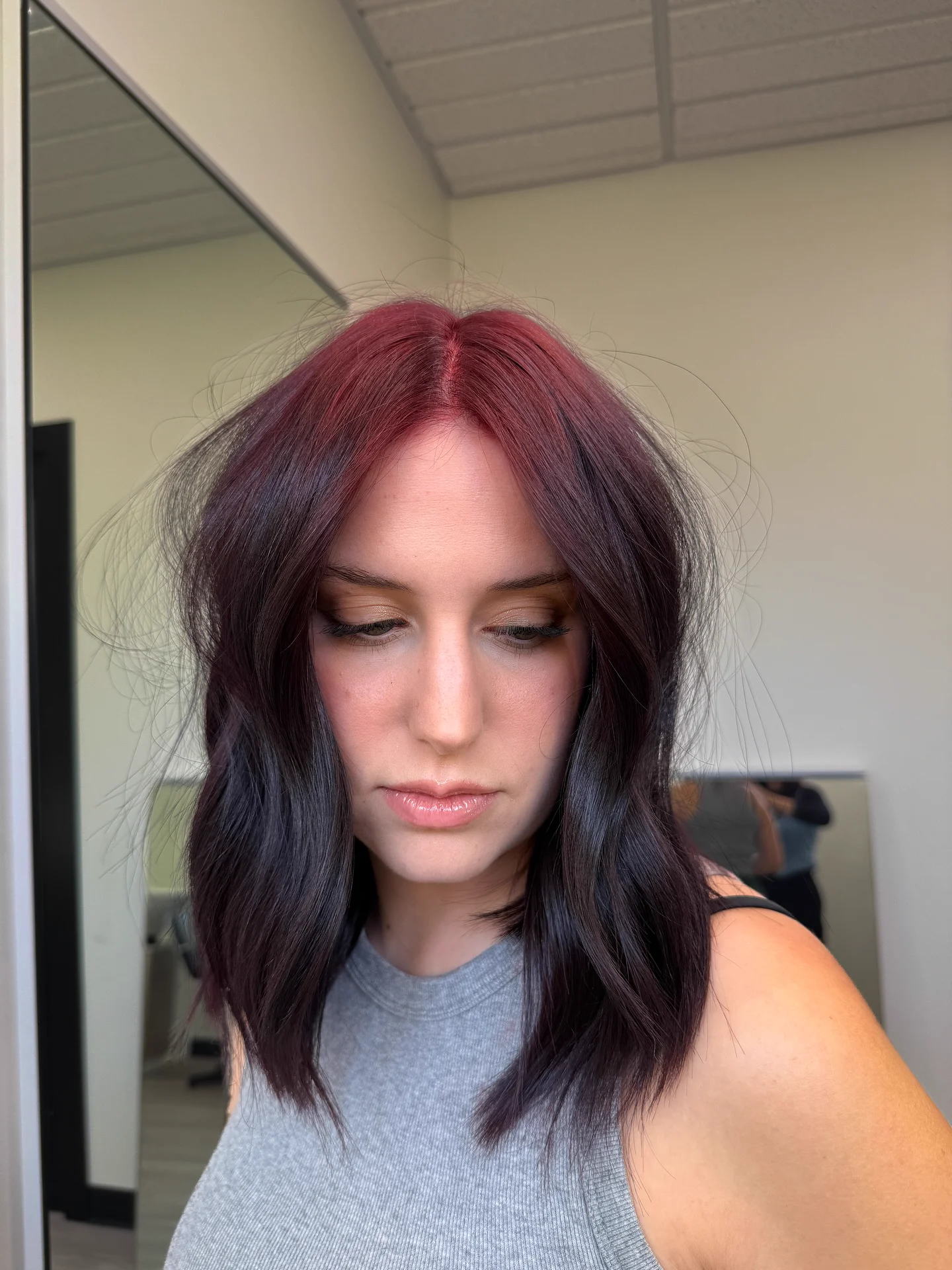
A full burgundy crown softened into brown lengths
The burgundy covers a broader crown than the stripe examples, but its diffused edge and related brown base keep the transition softer.
It demonstrates that ghost roots can have a melted boundary as long as the contrasting color still begins in, and is organized around, the root zone.
A broad diffused crown can tolerate some grow-out visually, but refreshing it may involve more product and more careful overlap control than a narrow part line.
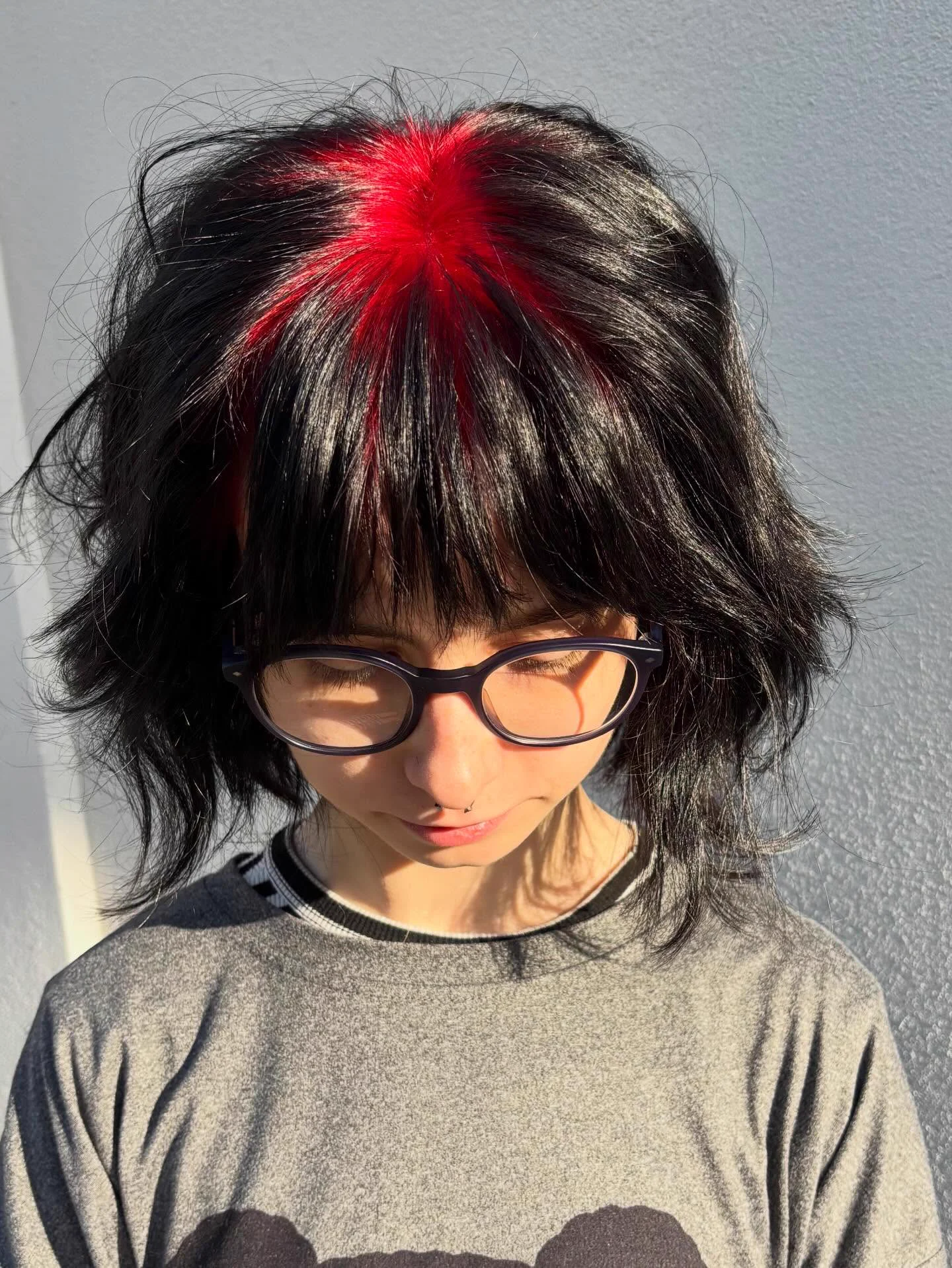
A vivid red crown burst that reaches the fringe roots
The elevated angle makes the placement map visible: red begins through the center crown, follows the top roots, and reaches the fringe without coloring the full lengths.
A front portrait can show the finished effect, but this view is better for discussing how the colored section connects from crown to fringe.
The irregular edge follows the wavy separation of the hair. It is intentionally less geometric than the sleek center-stripe example.

Copper-red roots carried into a micro fringe
The copper-red begins across the upper crown and continues into the short fringe, while the sides and lower waves remain predominantly black.
This is a quieter red than the vivid crimson examples. The slightly muted copper tone stays visible because the fringe repeats the root color at the front.
The micro fringe creates a second visible edge below the crown. A future fringe trim will therefore change part of the colored shape as well as the haircut.
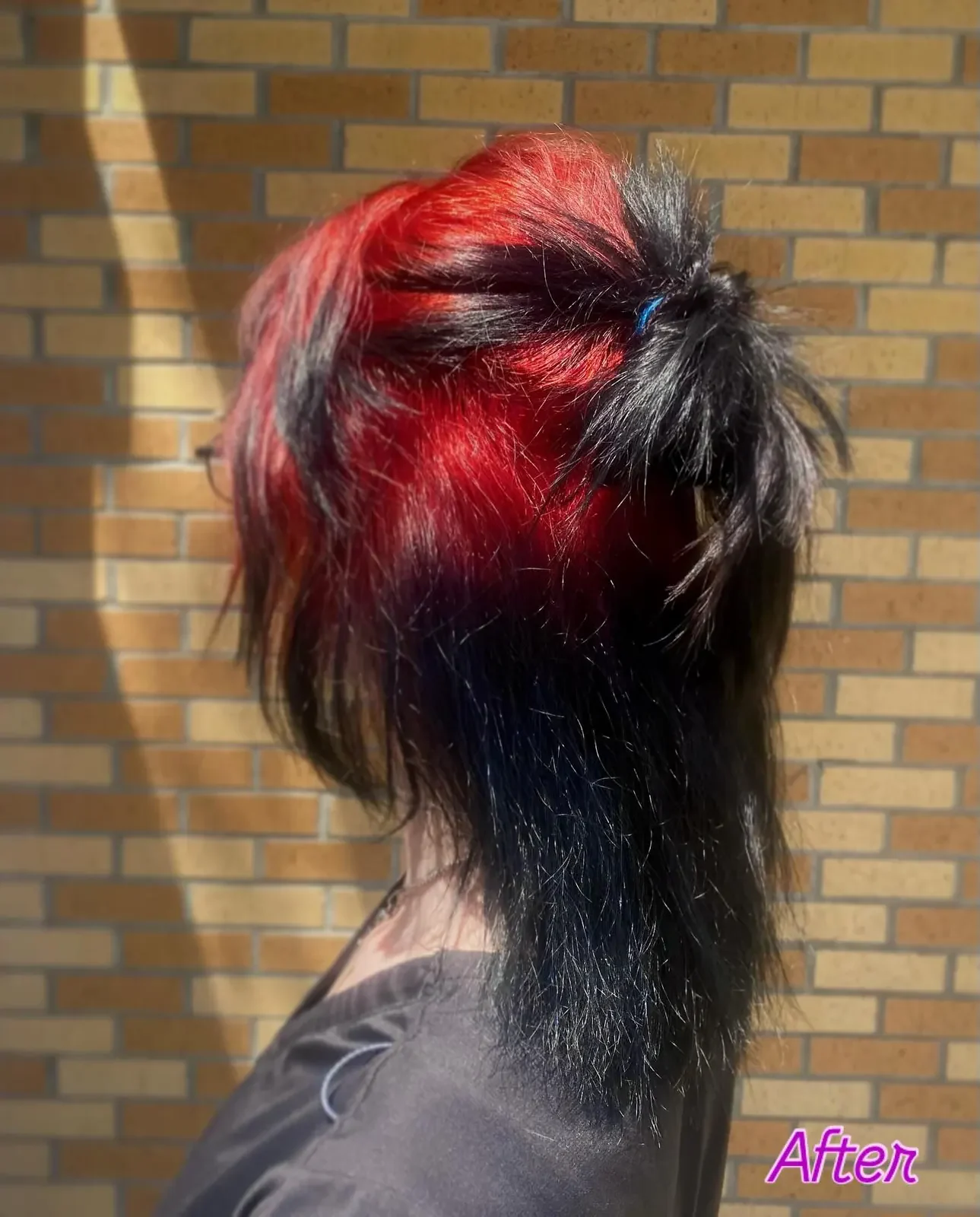
A crimson top panel gathered into an updo
Gathering the hair exposes the red panel from behind and shows how black sections can pass through it without hiding the root-first contrast.
An updo reveals more of the crown than loose hair, so a panel that feels moderate when worn down can look broader once the hair is lifted.
Use this angle when the color needs to work in tied-back styles. It communicates the rear boundary more clearly than a front portrait.

Split crimson roots styled into two small buns
The two red front sections begin at the part and feed into small buns, leaving the black lower hair and face-framing pieces visible.
The tied sections concentrate the red near the top. When released, the same color would fall farther into the front layers and appear less compact.
This reference is useful for someone who often wears half-up styles because it shows which colored sections will be gathered and which black pieces will remain loose.

An orange-copper crown above black curly waves
The orange-copper occupies most of the visible front crown, then stops sharply before the black curls take over through the sides and lengths.
This is the warmest example in the set. It should be used for an orange-led copper request, not as a reference for cherry or blue-based crimson.
Because the colored area is broad and bright, it reads as a crown feature rather than a narrow part-line accent. That difference affects both lightening and upkeep.

A compact copper crown on a short wavy bob
The short cut makes a modest copper section occupy a larger share of the visible silhouette, even though black still dominates the sides and lower fringe.
This is a useful comparison with the broad orange crown on longer curls. The color family is related, but the bob makes the placement feel more compact.
Reshaping the top layers can quickly alter where the copper ends. Plan the haircut and color boundary together rather than treating them as separate decisions.
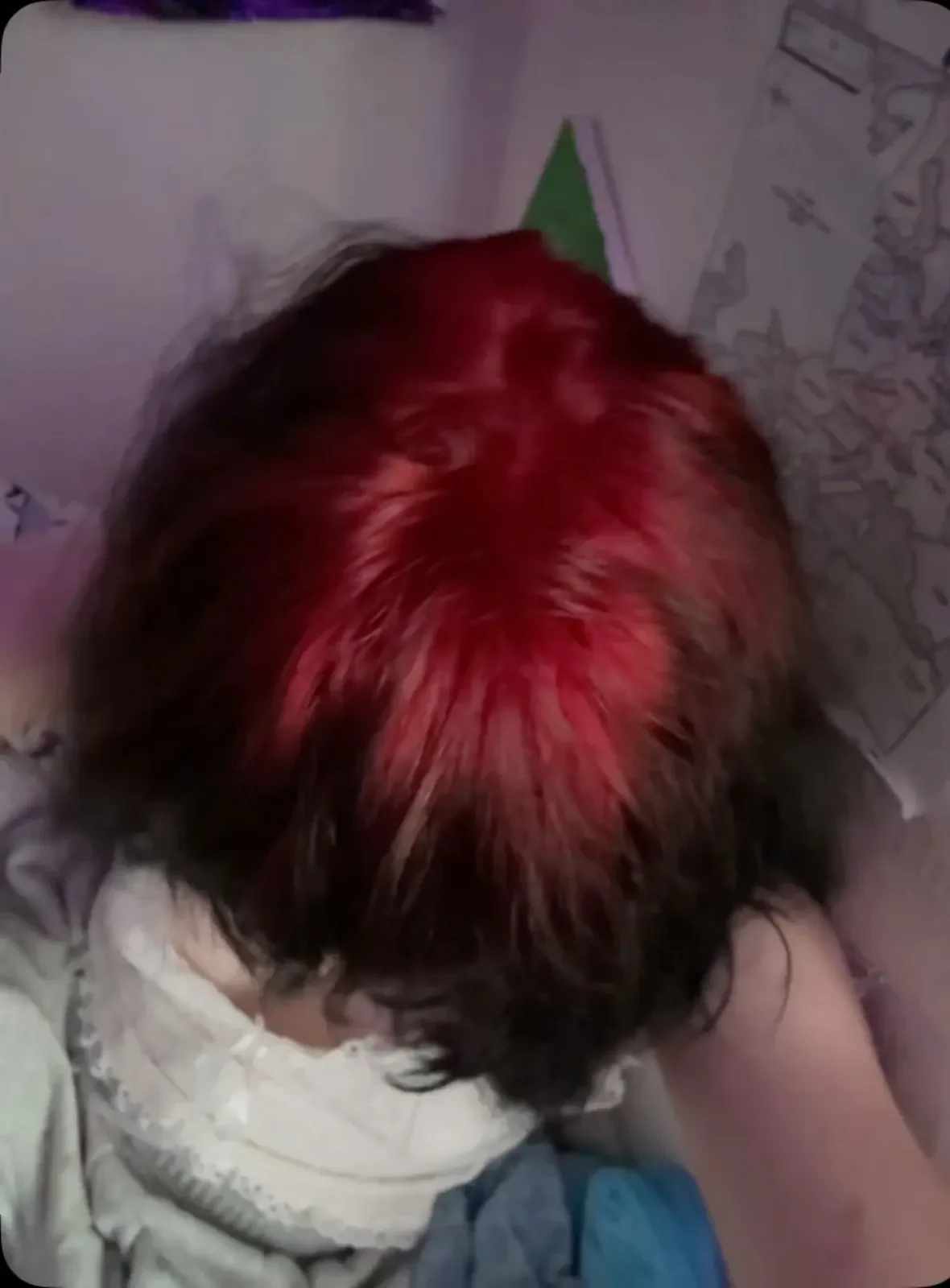
A burgundy crown shown from directly above
The overhead angle reveals the full burgundy footprint, including the darker perimeter that would be difficult to judge in a straight-on portrait.
This image is more useful for sectioning than for judging the finished face frame. It shows the actual width and rear edge of the crown panel.
The related brown base softens the edge of the burgundy, but the central root area remains clearly organized and visibly red.

Copper-orange split roots with long dark waves
Two copper-orange sections frame the part and travel into the split fringe, while the long dark waves preserve a strong base-color contrast.
The color is front-weighted rather than spread across the full crown. That makes it useful for someone who wants warmth around the face without coloring every top section.
Discuss how far the copper should travel down the fringe. Extending it farther creates a colored face frame; stopping earlier keeps the emphasis closer to the roots.
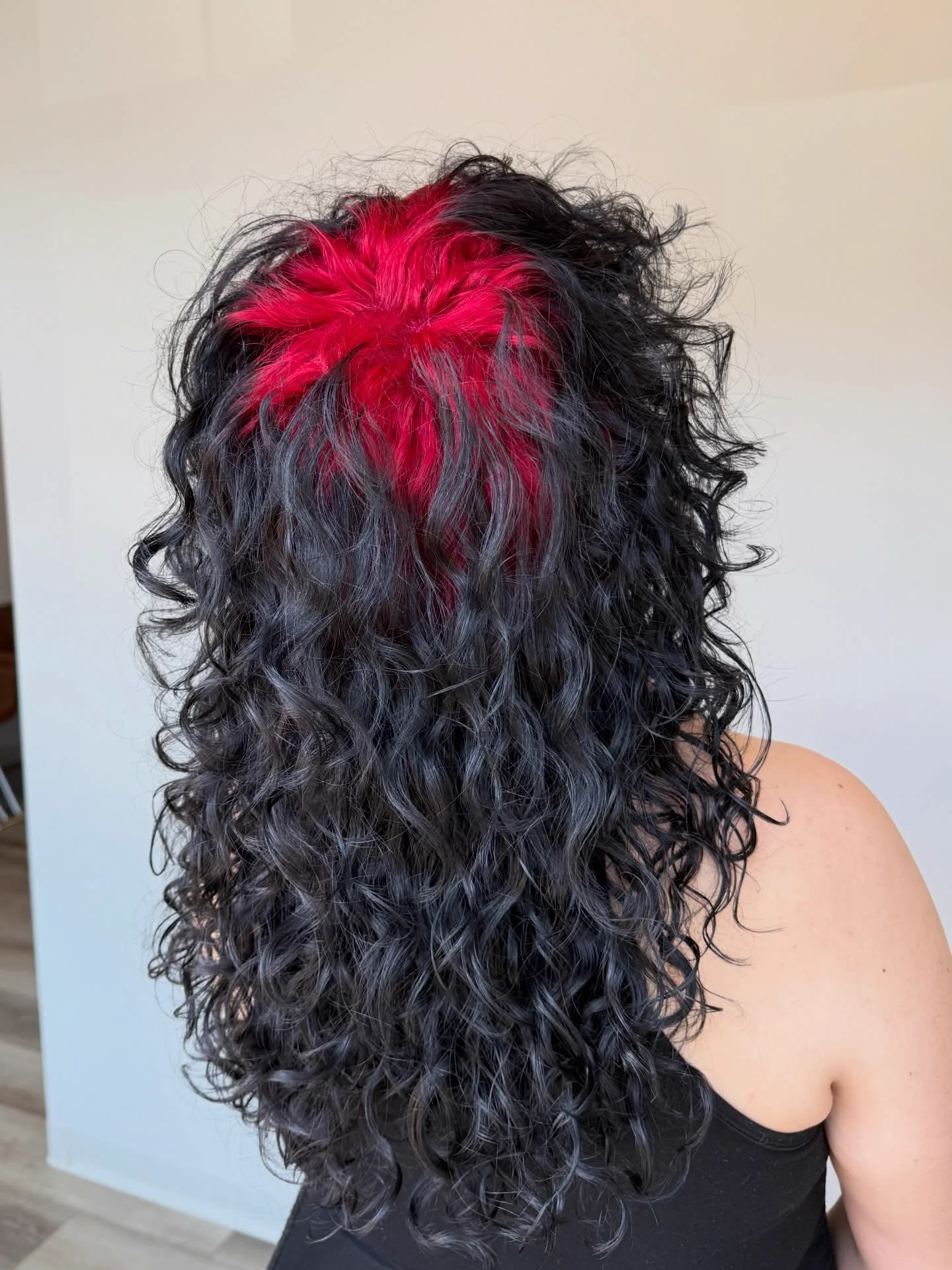
Hot-red crown roots breaking through long black curls
The hot-red panel is continuous close to the crown, then separates into irregular flashes as individual black curls twist through it.
This is a stronger back-view reference for curly hair than a smooth panel photograph. It shows why the boundary will look broken even when the root section is connected.
The red occupies the upper crown without continuing through the full curl length, which keeps the result recognizably root-led from behind.
Crimson, Cherry, Burgundy, And Copper do Different Jobs
Crimson gives the clearest high-impact contrast on black hair. It holds its identity in a narrow center stripe, a split fringe, or selected crown rows because the color remains visibly red even when the section is small.
Cherry red is still saturated, but usually reads slightly warmer and less severe than a blue-based crimson. It is useful when you want a clear red root against dark brown hair without the moodier cast of burgundy.
Burgundy trades brightness for depth. Against black lengths it remains visible as a wine-red root zone; against warm brown lengths it can form a softer root melt. Check the color in daylight before choosing it, since a very deep burgundy may look almost brown in low light.
Copper red brings orange warmth into the result. It connects naturally with auburn and brunette lengths, especially around a fringe or front root section. If your reference looks distinctly copper, asking only for "red" leaves too much room for a cooler result.
These families are not interchangeable refresh shades. A copper mask can pull a faded crimson toward orange, while a cool cherry product can flatten the warmth that made a copper placement work.
Keep The Strongest Red Attached to One Readable Root Zone
Red needs a readable boundary because it carries so much visual weight. Start by choosing the part of the haircut that should reveal the color most often:
- Center stripe: A narrow, symmetrical option that stays easy to read on sleek or straight hair.
- Split fringe: A front-weighted placement that works with bobs, shags, wolf cuts, and short waves.
- Crown panel: A broader section that breaks into smaller flashes of red when curls or waves move.
- Money-piece roots: A warmer, face-framing option that can remain smaller than a full crown panel.
- Side panel: An asymmetrical reveal whose visibility depends on the wearer's usual part.
- Selected braid rows: A scalp-adjacent placement that keeps the effect rooted even when the finished texture is braided.
A small connected section is often enough. Random pieces through the lengths may still be attractive, but they no longer explain the same root-first idea. If the terminology is still unclear, the ghost roots definition guide separates root placement from peekaboo panels, grown-out color, and ordinary regrowth.
The Base Color Decides Whether Red Looks Graphic or Blended
The same red formula can produce a very different finished effect on black, espresso, chestnut, or auburn hair. Black creates the strongest light-and-color contrast, so narrow crimson placements tend to look sharper. Dark brown reduces that jump and can make cherry or burgundy feel more integrated. Warm brunette and auburn lengths naturally support copper, but may not provide enough separation for a muted dark red.
Hair texture changes the edge as well. Straight hair exposes inconsistencies in stripe width. Waves repeatedly hide and reveal the transition. Curls can make one continuous crown panel look like several smaller red sections. Braids organize the color through visible root rows. The black-base examples in the gallery show how red stays legible when the surrounding hair is at its darkest.
Describe The Red by Temperature, Placement, Width, And Edge
Bring two or three references that agree on placement, even if their exact red differs. One front view explains the finished effect; a top or side view explains how far the colored section travels. Then describe the request using four concrete variables:
- Temperature: crimson, cherry, burgundy, true red, or copper-red.
- Placement: center part, fringe roots, full crown, side panel, front root section, or selected braid rows.
- Width: a narrow stripe, two sections beside the part, or a broader root wash.
- Edge: crisp, softly diffused, or melted into a related brunette base.
For example: "I want a narrow crimson center-part section on black lengths, with the same width at the hairline and crown." That gives a colorist a placement map. "Red roots" alone does not clarify whether you mean deliberate color, natural-looking regrowth, or a full top layer.
Ask how much lift your chosen red needs on the current base and what that lift means for future retouches. The ghost roots hair dye guide explains why depositing more red onto a faded section is a different service from lightening new dark growth.
Refreshing Existing Red is Not The Same as Lightening Dark Roots
An at-home red refresh is most predictable when the section is already lightened, the boundary is still where you want it, and the color has faded evenly. In that situation, a matching semi-permanent dye or depositing mask restores tone without redesigning the placement.
New dark growth is a different problem. Depositing red over it may create a muted tint rather than the brightness shown in a lifted reference. Extending the section, correcting a patchy boundary, or lifting close to the scalp also requires more precision than recoloring an established panel.
For an existing, even section, the useful kit is simple:
- Crimson, cherry, burgundy, or copper semi-permanent dye
- Red or copper color-depositing mask
- Small tint brush for part lines or fringe
- Gloves, clips, and barrier cream
- Color-safe shampoo and heat protectant
Protect the surrounding dark hair before applying a refresh, use a small brush near part lines, and follow the product's own timing. If the roots need lifting or the panel needs to be reshaped, treat that as a color service rather than a routine refresh.
Plan For The Way Your Chosen Red Fades
Judge maintenance by two separate changes: tone fade and boundary growth. Tone fade changes the red itself. Boundary growth creates a strip of natural hair between the scalp and the colored section. A depositing mask may help the first problem but does not solve the second.
Wash frequency, water temperature, heat styling, sun exposure, and the condition of the pre-lightened hair all affect how quickly red loses clarity. Fringe and face-frame placements are washed, touched, and heat-styled often, so they may need attention earlier than a hidden side panel. The maintenance guide helps separate a pigment refresh from a boundary retouch and gives you questions to ask before booking either one.
Red Loses Its Structure When The Placement Becomes Random
The most common failure is asking for a color without defining the section. A beautiful crimson can still feel wrong if the crown panel is twice as wide as expected. A burgundy reference can disappoint if it was photographed in bright daylight but the real result is judged indoors.
Avoid collecting references that contradict one another. A narrow center stripe, a broad runway root wash, and red face-framing lengths require different sectioning and upkeep. Pick the image that best communicates placement first, then use a second image to refine shade or texture behavior.
Also plan for the next version of the look. Ask whether the red should be refreshed in place, allowed to grow into a deliberate band, covered with the base color, or expanded later. That answer affects how aggressively the first section should be lightened and how much hair is included.
Red Ghost Roots FAQ
Do red ghost roots show on black hair?
Yes, red can show very strongly on black hair when the root zone is lifted enough first. Burgundy and dark red can be softer, while crimson and cherry need more brightness.
What red shade is easiest to maintain?
Burgundy and dark red are usually easier than bright crimson or cherry. Copper is wearable but needs the right refresh product so it does not fade too orange.
Can I refresh red ghost roots at home?
Yes, if you are refreshing an existing red section. Use a matching red or copper depositing mask and keep it on the intended root panel rather than pulling it through every length.
If you intend to let the placement move away from the scalp rather than retouch it, the grown-out ghost roots guide shows how that decision changes the visible band and the transition plan.